.png)
Last updated: May 2026
TL;DR
The best ABM tools in 2026 fall into six categories, each solving a distinct job in the account-based marketing workflow. The category winners: LinkedIn Sales Navigator for account research, UserGems for account prioritization, Userled for AI-native content personalization, full-funnel orchestration and activation, and sales enablement, Factors.ai for engagement analytics, Cargo for GTM orchestration, and HockeyStack for revenue attribution. No single platform wins all six, and any vendor claiming to is selling marketing language rather than architecture.
The deeper shift in 2026: the legacy multi-vendor ABM stack (six tools, six contracts, six implementation cycles) is being replaced by smaller, more integrated stacks built around AI-native execution platforms. Mid-market teams now run programs at $80K to $250K all-in that would have required $400K+ stacks two years ago. The economics changed because production speed changed: AI-native platforms compress what used to take weeks of marketing capacity into hours.
This guide is structured to help you build the stack honestly. The vendor picks below are based on third-party reviews, real pricing data from Vendr-tracked contracts and practitioner threads, and outcome data from customer case studies. The implementation guidance covers three maturity stages, from early ABM teams running 1-3 accounts through enterprise programs running 500+ accounts. Pick the platforms whose specialization matches your team's actual bottleneck, not the platforms with the loudest marketing.
Account-based marketing isn’t what it used to be. The scrappy days of hand-coding landing pages for every account are over. Modern ABM runs on intelligence — real-time intent signals, predictive AI, and orchestration engines that turn data into action before your competitors even know an account is in-market. An account based marketing platform is a specialized software solution for B2B marketing, designed to enable targeted outreach, deep personalization, and seamless data integration across sales and marketing teams.
But here’s the problem: The ABM software landscape is a mess. Dozens of vendors claim to “revolutionize” your go-to-market, but most are feature-incomplete platforms or niche point solutions that don’t talk to each other. Account based marketing solutions are essential tools that help businesses personalize outreach and engage high-value accounts more effectively.
After evaluating the top ABM tools across six critical categories, we’ve identified the real winners — platforms that actually deliver on the promise of scalable, personalized engagement. This guide covers the best account based marketing tools for 2026. This isn’t marketing fluff. These are tools driving measurable pipeline and revenue for B2B teams right now.
Quick Comparison: Best Account Based Marketing Tools 2026
What's changed in ABM tooling in 2026
The ABM software category has shifted more in the past 18 months than in the previous five years combined. Three structural changes are reshaping how teams build their stacks, and the picks below are calibrated to the 2026 reality, not the 2022 one.
1. AI-native architecture has become a real category. The first wave of "AI features" in ABM tools was generative AI bolted onto pre-AI platforms. The second wave (now emerging) is AI-native architectures where the AI is foundational rather than a feature. The diagnostic test: if you disabled the AI, would the platform stop functioning? AI-native platforms can't function without their AI; legacy platforms with AI features continue to function (slower and more manually). This distinction matters for buyers because it predicts production speed, time-to-first-campaign, and total cost of ownership.
2. Stack consolidation is replacing best-of-breed sprawl. The legacy ABM stack pattern (a separate vendor for each of the six jobs) made sense when each tool needed deep specialization to be useful. AI-native platforms increasingly span multiple jobs within a single workflow, which means modern stacks are smaller (3-4 vendors, not 6+), faster to deploy, and lower in total cost of ownership. Mid-market teams that ran $400K+ multi-vendor stacks in 2022 now run $80K to $250K integrated stacks producing the same or better pipeline outcomes.
3. Sales-led adoption has overtaken marketing-only platforms. ABM tools that require marketing operations to operate every workflow stall at the limit of marketing's capacity. Modern platforms are increasingly designed for direct sales-rep adoption: reps build their own personalized landing pages, microsites, and outbound assets without filing tickets with marketing. This shift has been the single largest predictor of which platforms compound versus which ones plateau, because every rep using a sales-led platform generates more pipeline activity than a centralized marketing team could produce alone.
The vendor picks below reflect these three shifts. Each category winner is evaluated not just on feature depth but on whether the architecture, operating model, and pricing fit the way modern B2B teams actually work in 2026.
What Actually Matters When It Comes to ABM Tools
Before diving into specific platforms, let’s cut through the noise. The best ABM platforms provide end-to-end solutions for every touchpoint in the buyer journey.
Here’s what separates real ABM tools from glorified email personalization:
1. Account Intelligence That’s Actually Intelligent
Generic firmographics are table stakes. You need tools that surface intent signals, buying committee changes, and competitive research activity – in real time.
2. Personalization That Scales
Creating one bespoke landing page is easy. Creating 500 personalized microsites without a dev team? That’s the actual challenge.
3. Orchestration, Not Just Reporting
Engagement data is useless if it sits in a dashboard. The best ABM tools trigger actions – route hot accounts to sales, serve dynamic ads, update CRM records – automatically. ABM tools provide a centralized platform for managing tasks, deadlines, and resources, improving collaboration between marketing and sales teams. Using ABM tools, marketing and sales teams can view the same data in a centralized place, enhancing collaboration.
4. Attribution You Can Trust
Multi-touch attribution sounds great until you realize most platforms can’t distinguish causation from correlation. Look for tools that show the full account journey, not just last-click credit.
5. Sales Activation That Goes Beyond Marketing
If your ABM platform doesn’t directly help sales reps close deals – with alerts, account insights, and recommended next actions – it’s a science project, not a revenue engine.
Some platforms stand out by integrating with other tools and offering a suite of various tools for ABM, lead generation, automation, and sales engagement, making them more versatile compared to other tools on the market.
1. Account Research & Intelligence: Identifying Target Accounts
The foundation of ABM is knowing which accounts to go after and who makes decisions within them. The best ABM tools provide comprehensive company profiles, enabling you to identify and analyze target companies with detailed information on their structure, key personnel, and financials.
These tools turn scattered data into actionable targeting and help generate leads that fit your ideal customer profiles (ICPs). With features that let you gain insights from company data and engagement signals, you can make more informed decisions about which accounts to prioritize.
Let’s take a look at some of the top tools for account research and intelligence to see which comes out on top.
Best for Account Research: LinkedIn Sales Navigator
Score: 9.5/10
LinkedIn Sales Navigator isn’t just a contact database—it’s a live window into how target accounts operate. While competitors serve stale firmographic data, Sales Navigator delivers real-time social signals that reveal buying intent and organizational shifts.
Why It Wins:
- Real-time intelligence: Job changes, promotions, hiring sprees, and content engagement signal when accounts are restructuring or entering buying cycles
- Buying committee mapping: Advanced filters drill down by title, seniority, department, and function to identify every stakeholder in complex deals
- Relationship leverage: TeamLink surfaces warm introductions through your network, dramatically improving outreach success rates
- CRM sync: Native Salesforce and HubSpot integration keeps account intelligence flowing into your existing CRM workflows
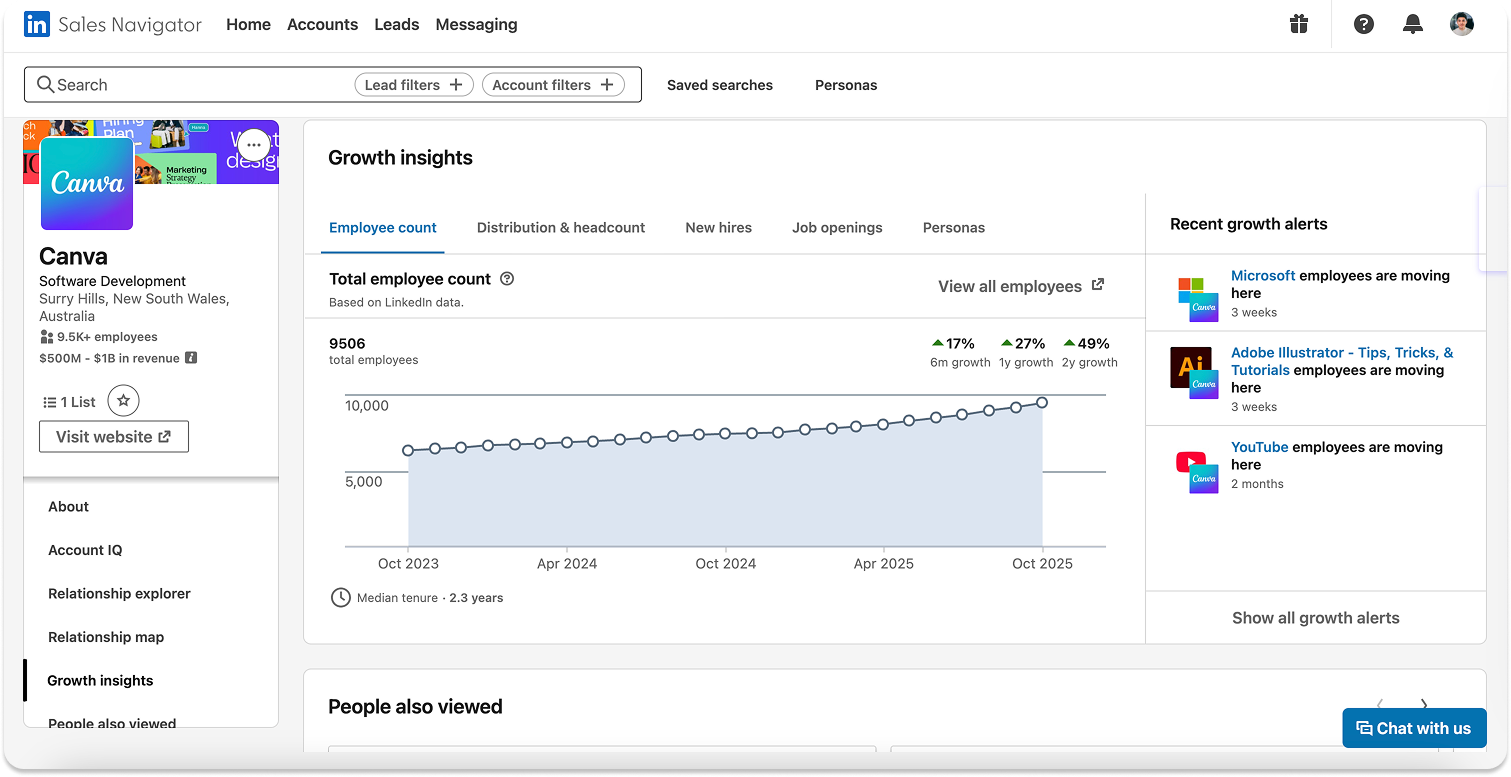
The Reality: Sales Navigator’s data isn’t perfect—profiles go stale, InMail limits restrict outbound volume, and the platform gets expensive fast for larger teams. But the relational intelligence it provides (who knows whom, what people are talking about, how org structures are shifting) is impossible to replicate with traditional B2B data providers.
When integrated with your existing CRM and tools like HubSpot, ABM tools help you find and prioritize high-value accounts, especially when combined with Sales Navigator’s real-time insights.
Real Impact: TetraScience, a life-sciences data platform, used Sales Navigator to map complex buying groups across enterprise accounts. By layering org-chart intelligence on top of external data, they identified hidden decision-makers and reduced wasted outreach by 40%.
Pricing: $64/month (Core) to custom enterprise pricing
Runner-up: ZoomInfo (9.0/10) — Best for breadth of contact data and intent signals, but weaker on real-time social intelligence and relationship mapping.
2. Account Selection & Prioritization: Timing is Everything
Knowing which accounts are ready to buy — before they talk to competitors — is the holy grail of ABM. Tracking account engagement and leveraging real time data are essential for prioritizing accounts, as they help you understand which target accounts are most interested and likely to convert.
These platforms use AI to score accounts based on fit, engagement, and intent. Predictive intent monitoring analyzes digital signals to identify "in-market" accounts before they fill out a form, allowing you to engage prospects earlier in their buying journey.
Best for Account Prioritization: UserGems
Score: 9.2/10
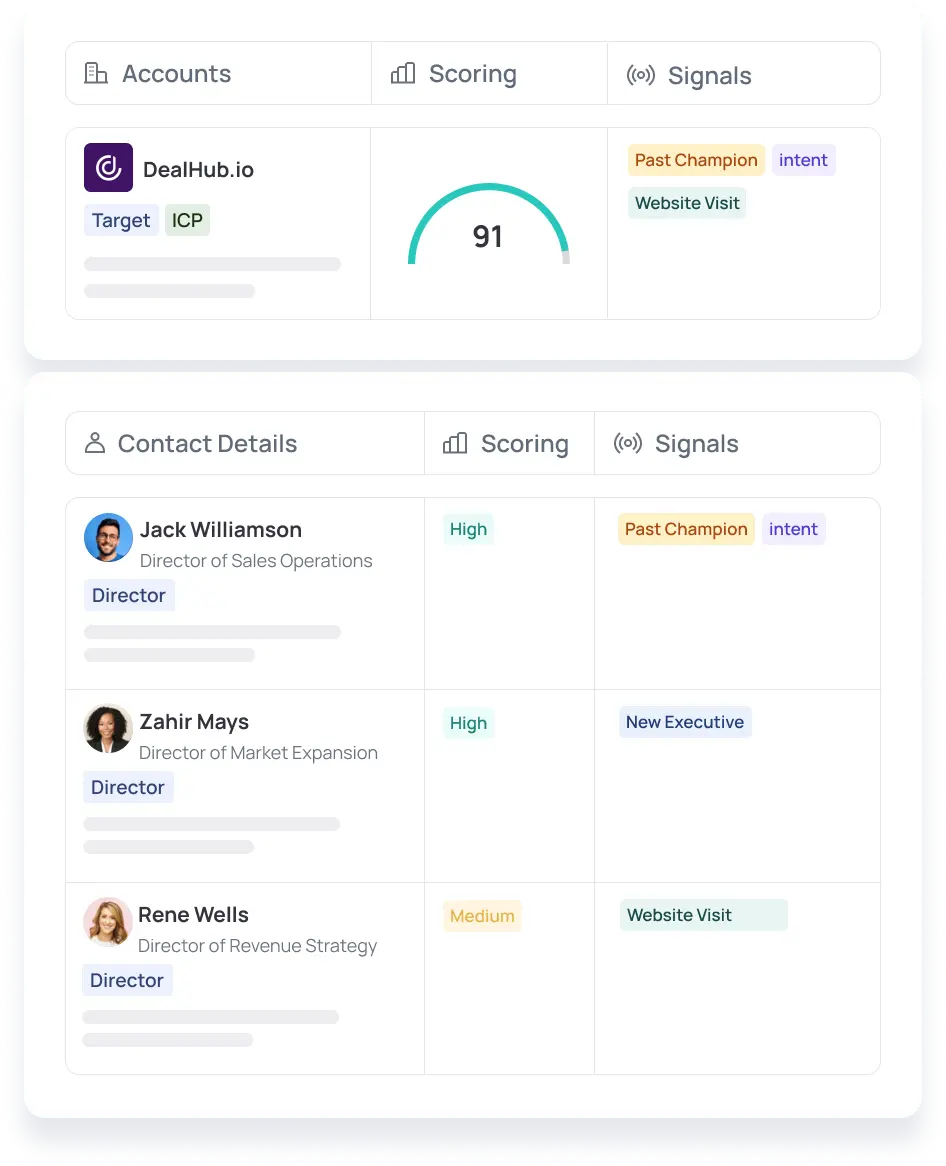
UserGems is the AI Command Center for outbound and ABM, the missing layer between your CRM (system of record) and your execution tools (system of action). While tools like 6sense excels at predicting anonymous in-market behavior, UserGems goes deeper: it captures and verifies contact-level signals, builds a custom scoring model trained on your sales history, and then deploys their AI agent, Gem-E to act on those insights automatically.
Why it wins:
- Custom AI scoring: Unlike black-box intent platforms, UserGems builds a scoring model unique to your GTM strategy and sales history. You see exactly why accounts are prioritized and can override when needed, no guesswork
- Signal precision over noise: 90%+ data accuracy on the signals that drive pipeline, job changes, intent shifts, website visits, tech stack changes, and account movements — verified in real time
UserGems comes with 21+ native contact- and account-level signals - from job changes, contact-level intent, and website visits to tech stack shifts, hiring, funding, M&A, and prior closed-lost context, and more
- Gem-E AI agents: Gem-E for Outbound builds lists, writes hyper-personalized email sequences, and automates CRM workflows. Gem-E for ABM identifies in-market accounts, measures TAM progression, and syncs dynamic audiences to LinkedIn Ads — keeping sales and marketing aligned without manual effort
- Works where your team already works: The AI Chrome Extension surfaces signals, scores, and next-best actions directly inside Salesforce, HubSpot, or your SEP, no extra tabs, no platform switching
The reality: For teams that want transparent, custom scoring built on their own data, and AI agents that actually take action rather than just surface dashboards, UserGems delivers something the legacy platforms can't.
Real Impact: UserGems customers see Gem-E produce 8–20% reply rates on AI-generated outreach, and accounts identified by UserGems convert 30% higher than those selected manually. Reps start each day with their pipeline already prioritized and sequences already queued.
Pricing: Contact for pricing. Backed by a money-back pipeline guarantee.
3. Content Personalization & Distribution: Breaking Through the Noise
Generic marketing is dead. B2B buyers now expect experiences tailored to their specific challenges, industry, and role. A landing page builder is essential for creating customized experiences that capture and convert leads without coding skills.
These tools make hyper-personalization scalable by offering campaign creation tools that help build targeted campaigns across multiple channels, engaging high-intent buyers with relevant content. Personalized content not only increases engagement but also achieves faster sales cycles by directly addressing buyer pain points.
Let’s take a look at the leaders in this category.
Best for Content Personalization & Activation: Userled
Score: 9.5/10
Userled solves the biggest bottleneck in ABM: producing personalized assets at the speed buying signals evolve. Most platforms let you swap company names in email templates. Userled is an AI-native ABM platform that generates fully customized microsites, landing pages, ad creative, and sales assets, end-to-end, without touching code or involving designers.
Why It Wins
- AI-native architecture, not AI bolted-on. The platform was designed in 2022 with generative AI as the production engine, not as a feature added later. Account-specific assets generate by working on real account data (CRM, intent, sales notes, technographic) rather than assembling templates with field substitution.
- End-to-end across the four jobs of ABM. Personalization, orchestration, and account-level analytics in a single workflow, integrated with leading account intelligence layers (Salesforce, HubSpot, 6sense, Demandbase) rather than competing with them.
- Sales-led operating model. Sales reps build their own 1:1 microsites, write their own email banners, and trigger their own account-specific ads. Engagement signals route to CRM and Slack in real time so reps know exactly when to follow up, with what context, on which account.
- Fastest time-to-first-campaign in the category. Customers typically launch live within 2 to 3 weeks of contract signature, including implementation, integrations, and full sales enablement.
- Transparent pricing with no implementation services minimum. Starts at $25K per year for sub-250-employee companies. Mid-market deployments typically run $35K to $80K all-in.
- First-party signal-driven, GDPR-compatible architecture. Operates primarily on first-party account data and account-level signals rather than third-party cookies and individual cross-site tracking, which matters increasingly as cookie deprecation completes.
The Reality
Userled is newer than legacy specialists Folloze, PathFactory, and Mutiny, which means a smaller G2 review base in absolute terms (though growing rapidly). Content engagement analytics on existing legacy content libraries are less mature than dedicated analytics platforms like PathFactory. Teams that need a 5+ year vendor track record may find Userled too early in maturity. But the speed and quality of personalization without dev resources, paired with the end-to-end coverage, make it the clear winner for ABM teams that want to activate target accounts and accelerate deals from a single platform.
Real Impact
- Omnea: 30% increase in successful enterprise deals, 30+ meetings booked in one quarter, £1M+ in supported pipeline, 4x increase in reply rates with Userled pages in sequences. Sales reps build 30+ personalized landing pages per week.
- 8am (FinTech parent of LawPay and CPACharge): 60% reduction in content production time, 3x increase in target account engagement, 41% faster deal cycles, 2.5x lift in MQOs from accounts served personalized content vs. static.
- Pigment: Sales-led adoption across the entire revenue team. "Microsites, LinkedIn ABM ads, and sales follow-up are all unified in a single experience, which directly impacts pipeline creation and deal progression." (Louis Uguen, Growth Lead, Pigment)
- Onfido: 120% increase in enterprise demo bookings via ICP-segmented landing pages.
- Coverflex: $1.3M in supported pipeline from a 2-person marketing team.
- Aggregate: 67% average engagement uplift on personalized 1:1 campaigns, 27% increase in pipeline from target accounts.
Pricing
Starts at $25K per year for sub-250-employee companies. $2K per month entry tier.
Runner-up
Folloze (8.5/10) — Mature content hub builder with deep buying-committee experience. Best for teams whose primary need is curated multi-asset content experiences for late-stage enterprise deals rather than AI-native production at speed. Pre-AI architecture with AI features added in 2024+.
Mutiny (8.5/10) — Best-in-class for live-website personalization specifically (swapping headlines, CTAs, and modules on the corporate marketing site for known visiting accounts). Median contract ~$37,800/year, with $15K to $100K+ in enrichment costs commonly paired (Clearbit, 6sense). Specialized rather than end-to-end.
4. Engagement Tracking & Predictive Analytics: Know What's Working
The best ABM tools don’t just track clicks—they decode behavior. By tracking website visitors, these platforms help you understand account engagement and gain insights into which accounts are moving toward purchase and which are stalling.
When it comes to analytics, tracking and measuring the results of ABM campaigns is essential for understanding ROI. These insights allow you to refine your strategy and focus on the accounts most likely to convert.
Let’s take a look at the top contenders in this category.
Best for Engagement Analytics: Factors.ai
Score: 9.0/10
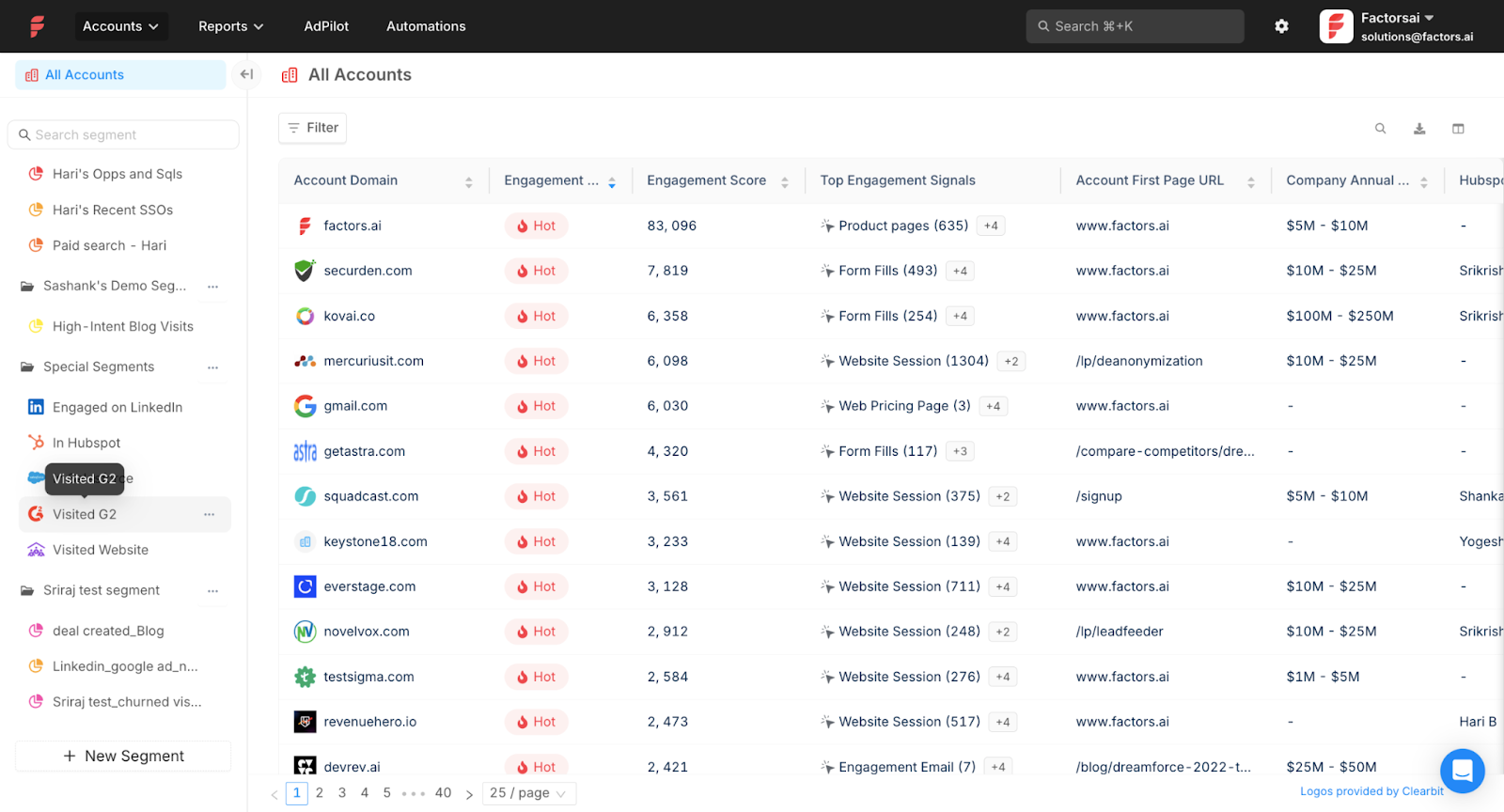
Factors.ai turns every touchpoint into intelligence. It de-anonymizes anonymous website visitors, maps multi-touch journeys, and uses predictive models to score account readiness—all in one platform.
Why It Wins:
- Visitor de-anonymization: Recovers company identities behind anonymous website visitors and links behavior to specific accounts
- Multi-touch attribution: Connects ad clicks, website visits, and CRM interactions to show which channels actually influence deals
- Predictive scoring: Real-time AI models use real time data to predict conversion likelihood based on engagement patterns
- Workflow automation: Triggers alerts and actions when accounts hit engagement thresholds, keeping sales in sync
The Reality: Attribution is messy. Distinguishing ad-driven traffic from organic engagement isn’t always clean, and the platform requires solid CRM data hygiene to work well. But Factors.ai‘s unified view of the account journey—from first touch to closed-won—is clearer than most competitors.
Real Impact: AudienceView used Factors.ai‘s account scoring and intent signals to identify hot accounts. Result: 15% of Q4 2024 pipeline came from Factors-flagged accounts, which converted 8x faster than cold outreach.
Pricing: Starts at $399/month
Runner-up: AdRoll ABM (8.5/10) — Good ad-level engagement reporting and ML-driven optimization, but less sophisticated predictive analytics. Leadfeeder helps you identify companies that visit your websites.
5. GTM Orchestration: Turning Data Into Action
GTM orchestration is where ABM shifts from passive reporting to active revenue generation. These platforms route accounts, trigger workflows, and guide reps with real-time next-best actions. Orchestration enables the launch and management of marketing campaigns and targeted ad campaigns, ensuring precise audience engagement across multiple channels.
Workflow automation in ABM tools empowers teams to coordinate outreach efforts and sales outreach, allowing for timely, personalized communication with high-value accounts. By streamlining these actions, ABM strategies can significantly speed up the sales process and improve conversion rates.
Let's have a look at the leaders.
Best for GTM Orchestration: Cargo
Score: 9.2/10
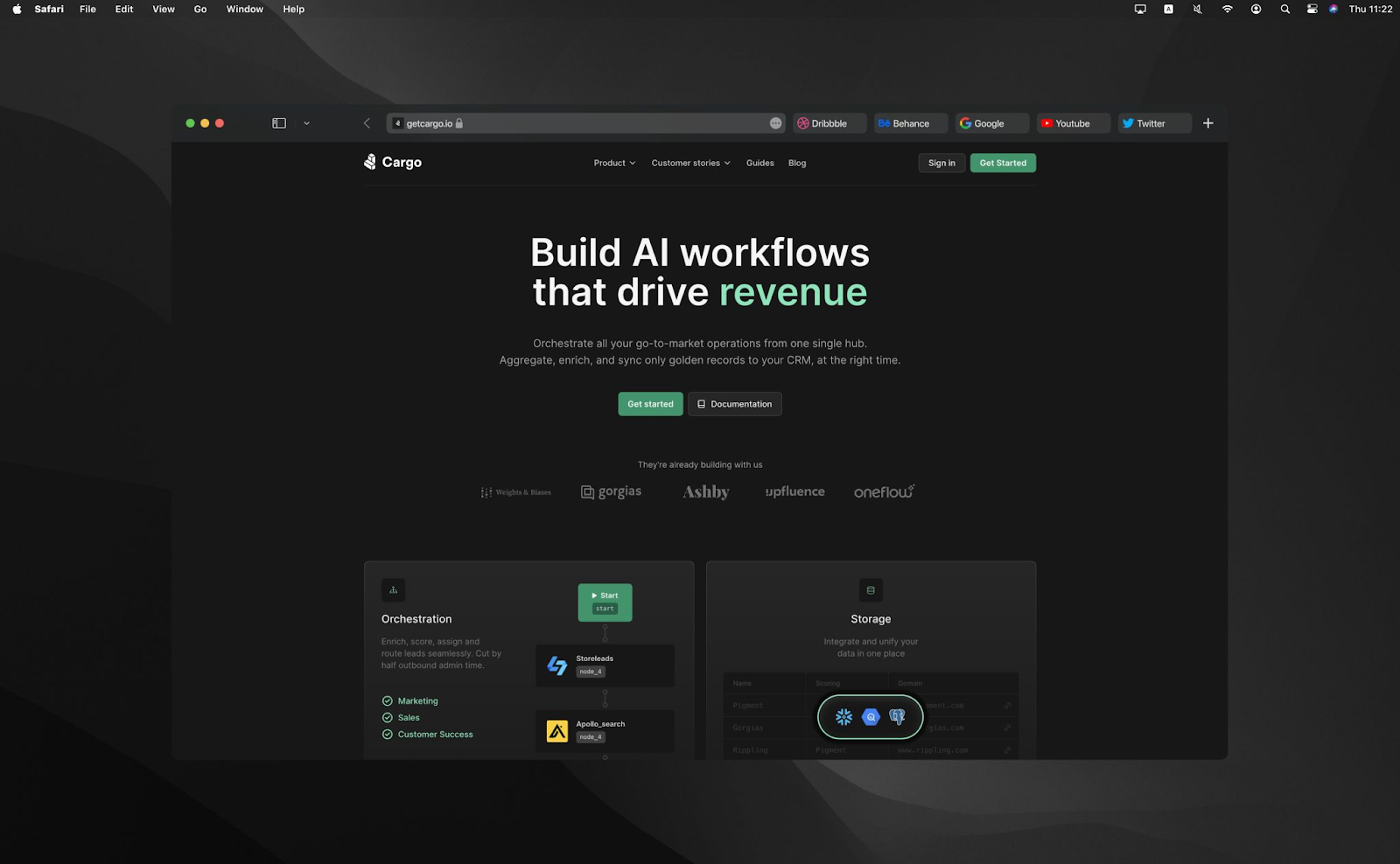
Cargo represents a new generation of revenue orchestration—built for modern data stacks, not legacy CRMs. It sits on top of your data warehouse and automates GTM workflows (scoring, routing, enrichment) without rigid UI constraints.
Why It Wins:
- Composable architecture: Headless design integrates with CRMs, marketing automation platforms, and data warehouses without forcing you into a proprietary interface
- AI-driven automation: Dynamic segmentation, intelligent routing, and prescriptive next-step guidance—powered by machine learning
- Agents & assistants: Build custom GTM workflows that surface insights and triggers directly in Slack, eliminating context-switching
- Predictable pricing: Usage-based model with accessible entry point (unlike opaque enterprise licensing)
The Reality: Cargo is newer and less battle-tested at massive scale. It requires GTM ops or engineering resources to configure complex workflows. But for teams that want modern orchestration without legacy platform lock-in, it’s the clear choice. ABM platforms like Cargo require sales and marketing teams to work closely together to target high-quality accounts, ensuring alignment and maximizing campaign effectiveness.
Real Impact: Gorgias’ GTM engineering team used Cargo to replace static email segmentation with dynamic, AI-driven outreach. By building conditional flows and integrating external APIs, they increased conversion rates 70% over previous campaigns.
Pricing: ~$3K/month (50K credits)
Runner-up: LeanData (9.0/10) — Strong routing and lead-to-account matching, but less flexible for multi-channel orchestration beyond the CRM.
6. Pipeline Insights & Revenue Attribution: Proving ROI
Attribution is where most ABM programs fall apart. These platforms finally make it possible to connect marketing spend to closed revenue—at the account level. ABM software can also make it easier to see the ROI all in one place, providing a clear view of which efforts are driving results.
With detailed analytics, you can track account engagement and sales engagement as key metrics, helping you understand which outreach strategies are most effective. Improved ROI focuses resources on high-value prospects, reducing wasted spend and increasing deal size.
Best for Revenue Attribution: HockeyStack
Score: 9.1/10
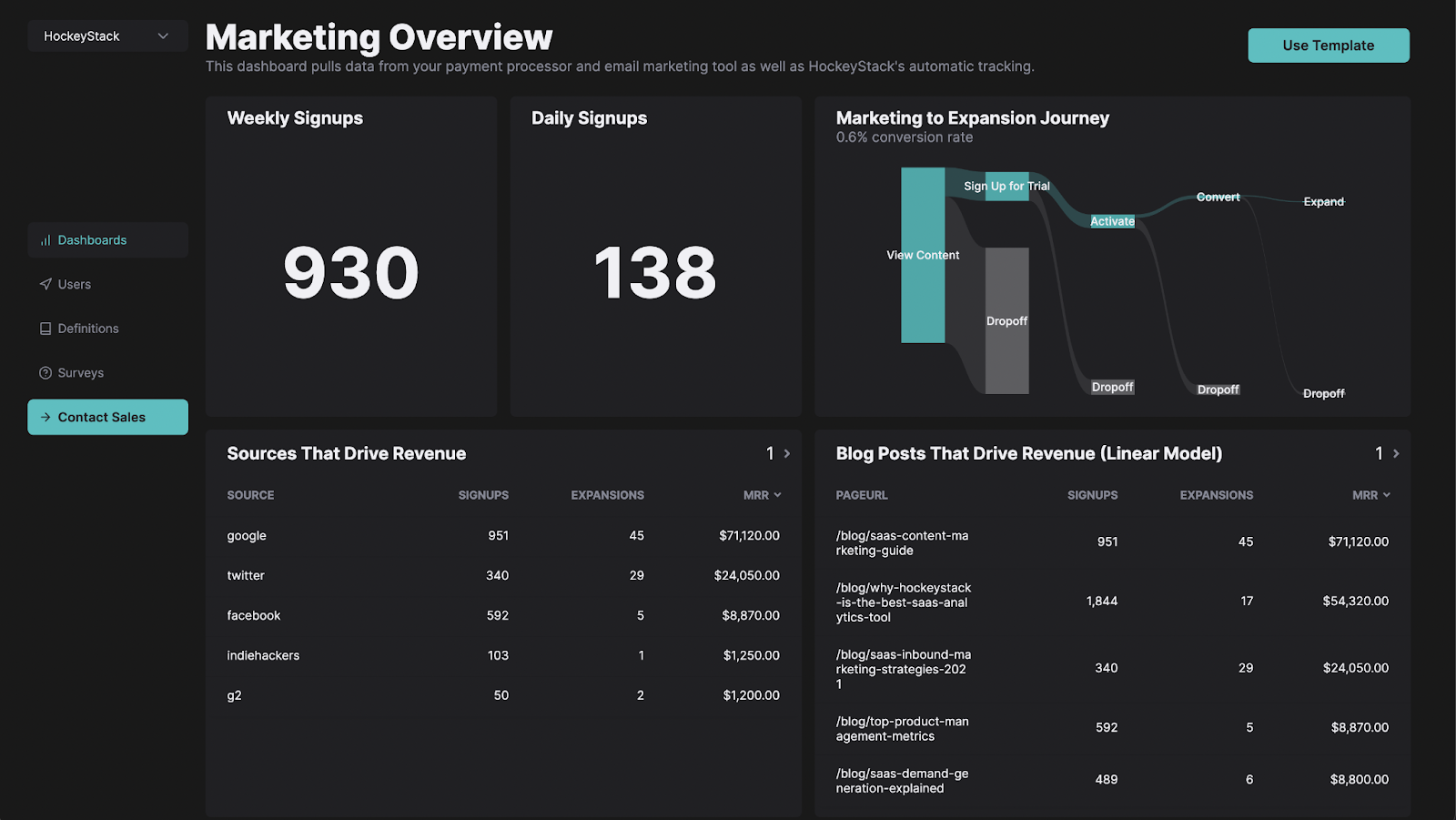
HockeyStack delivers what every CMO and RevOps leader wants: full-funnel visibility across marketing, sales, and product touchpoints. Its unified data model connects CRM, web analytics, and ad platforms without duct-tape integrations. As ABM tools have shifted from static list management to AI-driven intent signaling and omnichannel orchestration by 2026, HockeyStack exemplifies this evolution with its advanced capabilities.
Why It Wins:
- Unified data foundation: Connects CRM, ad networks, and product analytics natively—no manual stitching required
- Account-level attribution: Multi-touch models show which campaigns, channels, and reps influence each deal
- Visual journey maps: Interactive dashboards reveal how accounts move through the funnel, highlighting drop-off points
- AI-powered reporting: Odin AI agent generates custom reports from natural language queries, providing detailed analytics
The Reality: HockeyStack’s custom event tracking can be complex for fragmented data environments. Customization is somewhat limited to predefined attribution models. But for most B2B teams, the out-of-the-box visibility is more than enough.
Real Impact: RudderStack used HockeyStack to unify attribution across multiple models. With spend, cost-per-lead, and cost-per-pipeline in one platform, they achieved 3x attributed pipeline from organic search, reduced ad spend, and gained 100% attribution visibility.
Pricing: Custom (contact sales)
Runner-up: Dreamdata (8.7/10) — Mature attribution framework and strong integrations, but less flexible reporting and higher setup effort.
Implementation and Best Practices for ABM Tools
Rolling out account based marketing software is more than just a technology upgrade — it’s a strategic shift that requires careful planning and collaboration between sales and marketing teams. To get the most from your ABM tools, start by integrating multiple platforms, such as your marketing automation system, CRM, and data studio, to create a unified view of your target accounts. This integration ensures that all relevant data and insights are accessible across teams, supporting coordinated marketing and sales efforts.
Next, work together to define your ideal target accounts, develop personalized messaging, and design multi channel campaigns that reach decision-makers across various platforms. Leveraging marketing automation, you can streamline campaign creation and ensure consistent, timely outreach. Regularly monitor campaign performance using detailed analytics and predictive analysis to identify what’s working and where there’s room for improvement.
Ongoing training and support are also crucial — ensure your sales reps and marketing teams are equipped to use the full capabilities of your ABM tools, from campaign creation to real-time reporting. By following these best practices and leveraging the right account based marketing software, companies can maximize the impact of their ABM strategy, drive higher engagement, and achieve significant revenue growth.
How to Build Your ABM Stack in 2026
Most teams don’t need every tool on this list. When building your ABM stack, consider including a marketing hub, such as HubSpot Marketing Hub, to streamline your marketing efforts with features like personalized content, inbound marketing tools, and automation workflows. These platforms can serve as the foundation, while various tools for lead generation, automation, and sales engagement can further enhance your campaigns.
Here’s how to approach stack-building based on your maturity and resources: Evaluate your core needs first, then look at other tools that can complement your main platform, such as sales intelligence or data analysis solutions. Integrating various tools ensures your team has the flexibility to adapt and scale as your ABM strategy evolves.
Stronger sales and marketing alignment through ABM tools improves coordination by providing shared goals and visibility, leading to increased efficiency across your business.
Stage 1: Early ABM (1-3 accounts, manual effort)
- Account research: LinkedIn Sales Navigator
- Personalization: Userled (microsites + ads)
- Direct mail: Consider using direct mail as a channel for early ABM efforts. Direct mail can enhance engagement in multichannel campaigns and help track ROI for targeted prospects.
- Analytics: HubSpot/Salesforce native reporting
Stage 2: Scaling ABM (50-200 accounts, small team)
- Account research: LinkedIn Sales Navigator + ZoomInfo
- Prioritization: 6sense or Demandbase
- Personalization: Userled
- Analytics: Factors.ai
- Orchestration: Userled, Native CRM workflows + Chili Piper
Stage 3: Enterprise ABM (500+ accounts, dedicated team)
- Full stack: Sales Navigator + 6sense + Userled + Factors.ai + Cargo + HockeyStack
- Specialized additions: Reachdesk (gifting), Commonroom (community signals), sales enablement (key capability for enterprise ABM teams)
The Bottom Line
The ABM tools landscape has matured dramatically. The winners in 2026 aren't trying to be all-in-one platforms—they're best-in-class specialists that integrate seamlessly.
Our top picks:
- Account research: LinkedIn Sales Navigator
- Prioritization: 6sense
- Personalization: Userled
- Analytics: Factors.ai
- Orchestration: Cargo
- Attribution: HockeyStack
But the real differentiator isn't the tools—it's how you use them. The best ABM teams don't chase vanity metrics like impressions or clicks. They obsess over account velocity, buying committee coverage, and pipeline influence.
Start with personalization and intelligence (Userled + Sales Navigator). Layer in prioritization as you scale (6sense). Add orchestration and attribution once you're running at volume (Cargo + HockeyStack).
The future of ABM isn't more tools—it's smarter integration of the right ones.
FAQ: ABM Tools
What are ABM tools? ABM (account-based marketing) tools are software platforms that help B2B teams identify, prioritize, engage, and measure high-value target accounts. Unlike traditional marketing automation, ABM tools focus on account-level personalization and orchestration rather than individual lead generation. Key focuses of ABM tools include sales engagement—automating and personalizing multi-channel outreach for sales teams—and account engagement, which tracks and analyzes how target accounts interact with sales and marketing efforts.
How much do ABM tools cost? Pricing varies dramatically:
- Entry-level tools: $400-$2,000/month (Factors.ai, Userled)
- Mid-market platforms: $5,000-$15,000/month (Demandbase, Terminus)
- Enterprise solutions: $60,000-$150,000+/year (6sense, ZoomInfo)
What’s the best ABM tool for small businesses? For teams under 50 employees, start with LinkedIn Sales Navigator ($64/month) for account research and Userled ($2K/month) for personalized content. Both deliver enterprise-grade ABM capabilities without requiring large budgets or dedicated ops teams.
How do I choose an ABM tool? Prioritize based on your biggest bottleneck:
- Struggling to identify target accounts? → Account intelligence (Sales Navigator, ZoomInfo)
- Can’t personalize at scale? → Content personalization (Userled, Folloze)
- Want to run ABM campaigns at enterprise scale without the price tag? (Userled)
- Don’t know which accounts are ready to buy? → Predictive prioritization (6sense, Demandbase)
- Want to run full-funnel campaigns with a few clicks? (Userled)
- Can’t prove marketing ROI? → Attribution (HockeyStack, Dreamdata)
What’s the difference between ABM software and marketing automation? Marketing automation platforms (like HubSpot, Marketo) are designed for lead generation—capturing individual contacts and nurturing them through email sequences. These platforms often integrate with ABM tools to automate personalized marketing and outreach activities, such as triggering gifts or direct mail based on campaign data. ABM tools are designed for account penetration—coordinating multi-stakeholder engagement across multiple channels with personalized messaging. Most mature B2B teams use both in tandem.
What is AI-native ABM, and how is it different from legacy ABM with AI features?
AI-native ABM platforms are built from the ground up with AI as the production engine. Account-specific assets generate by AI working on real account data, not by templates with field substitution. Legacy ABM platforms with AI features have AI added on top of pre-AI architecture; remove the AI feature and the platform continues to function (slower and more manually). The diagnostic test (the "two-account test"): ask the vendor to generate output for two real accounts side-by-side. AI-native platforms produce materially different output for each; templated platforms produce nearly identical output with different copy.
How long does it take to launch an ABM platform?
It depends entirely on the platform architecture. AI-native ABM platforms typically launch live within 2 to 3 weeks of contract signature. Legacy specialists (Folloze, PathFactory) typically run 4 to 8 weeks. Enterprise platforms (6sense, Demandbase) typically run multi-quarter for full multi-module deployment. Time-to-first-campaign is one of the strongest predictors of whether an ABM program produces pipeline in year one or year two; every week spent in implementation is a week the program produces no pipeline.
How do I evaluate whether an ABM platform's AI is actually useful?
Three diagnostic tests. First, the "two-account test": ask the vendor to demonstrate the AI feature on two real accounts side-by-side, ideally accounts you suggest rather than curated demo accounts. Genuine AI-native architectures produce materially different output for each. Second, ask the vendor to disable the AI for 60 seconds and attempt the same workflow. AI-native platforms can't perform the workflow without AI; AI-augmented platforms continue functioning more slowly. Third, ask about the data sources the AI generates from: AI grounded in CRM, intent, and sales notes produces account-specific output; AI generating from generic prompts produces plausible-sounding but generic content.
When should I consolidate vs. add specialists to my ABM stack?
Consolidate when (a) you're production-bottlenecked rather than data-bottlenecked, (b) your team is mid-market and doesn't have ops capacity for 6+ vendor contracts, (c) total cost of ownership is becoming a procurement issue, or (d) implementation overhead from multiple vendors is delaying time-to-pipeline. Add specialists when (a) you have a specific deep-specialty need that no integrated platform handles well (e.g., dedicated content engagement analytics on a substantial existing content library), (b) you have ops capacity to manage multi-vendor integration, or (c) you're enterprise-scale with budget headroom and existing investments to protect. Most mid-market teams in 2026 are consolidating; most large enterprises maintain or extend best-of-breed stacks.
The next era of ABM won’t be defined by who has the most tools, but by who uses them to create meaningful, measurable connections with their most valuable customers.
Now’s the time to build your stack, align your teams, and shape the future of how your business wins high-value accounts.


Author

Generated £1.3M pipeline by focusing on UTM parameters personalisation.


Generated £1.3M pipeline by focusing on UTM parameters personalisation.